
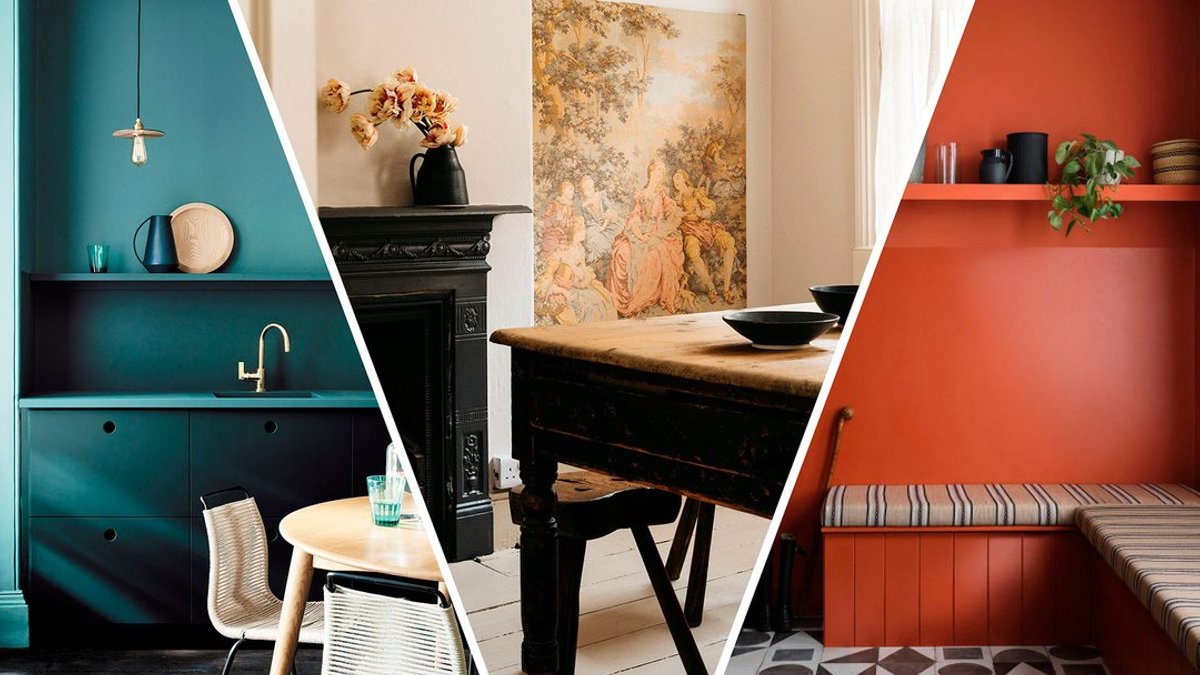
Paint names can be poetic, baffling, or so unusual they linger in memory long after the color fades. A handful have become favorites—not because the shade is extraordinary, but because the name turns an ordinary wall into something worth discussing.
Dead Salmon: A color with a 200-year-old invoice
Farrow & Ball’s Dead Salmon makes people pause. The name sounds like a joke, but its origins are practical. It comes from an 1805 painter’s bill discovered at Kedleston Hall in Derbyshire. The document described the library walls as “dead salmon”—“dead” for the flat, matte finish, and “salmon” for the warm, muted pink tone.
The color divides opinion. Some see a strong mushroom, others a neutral beige, and a few insist it leans toward a deeper pink. It shifts in different lighting, which may explain why it suits candlelit dining rooms. A 2.5-liter tin sells for £64 per 2.5L.
Related: Rare pink daffodil needs gardeners help
Interior stylist Sara Austin used it in her utility room, where the name’s oddness fits among cleaning supplies. Annabel Grimshaw selected it for a more refined space, showing the shade works in both practical and elegant settings.
Elephant’s Breath: A gray with a long history
Elephant’s Breath is another Farrow & Ball staple, though its roots go back further than most realize. The name first appeared in 1874, described as “a beautiful shade of blue with a mistiness.” By the mid-20th century, English designer John Fowler revived it as a warm gray with a hint of magenta.
In cooler light, the color can look lilac, making it adaptable in west-facing rooms. Like Dead Salmon, it sparks debate—some see a soft gray, others a faint purple. A 2.5-liter tin sells for £64 per 2.5L.
Related: King Charles sniffs Beckham rose
Other brands also excel at unusual names. Edward Bulmer Natural Paint’s Wash Stop was inspired by an old painter’s bill charging for “wash, stop and paint three times in oil.” The name reflects both the process and the color—a pale, soapy gray with a touch of lavender. It sounds unappealing until seen in person, where it appears elegant and subtle. A 2.5-liter tin costs £66 per 2.5L.
Mummy: A color with an unsettling origin
If Mummy sounds disturbing, that’s intentional. The name refers to the brownish hue of ancient Egyptian remains, and for centuries, the pigment was made from ground mummies. By the late 1800s, the practice ended, but the name remained. Today, the color is warm and inviting, far removed from its grim past.
The founder of the paint company notes the term even appears in Shakespeare’s works. A 2.5-liter tin costs £66 per 2.5L.
Related: Gardens steal show at Commonwealth Games
Tea With Florence, a rich teal from Little Greene, takes its name from Claydon House in Buckinghamshire. Florence Nightingale, sister of the home’s owner, often visited. The color was inspired by the Chinese Room, a space filled with chinoiserie that hosted generations of the Verney family.
Most of these names won’t appear on standard color charts. They make people smile, raise eyebrows, or pause mid-conversation. In a world where most paint swatches blend into the background, that’s often the goal.


