
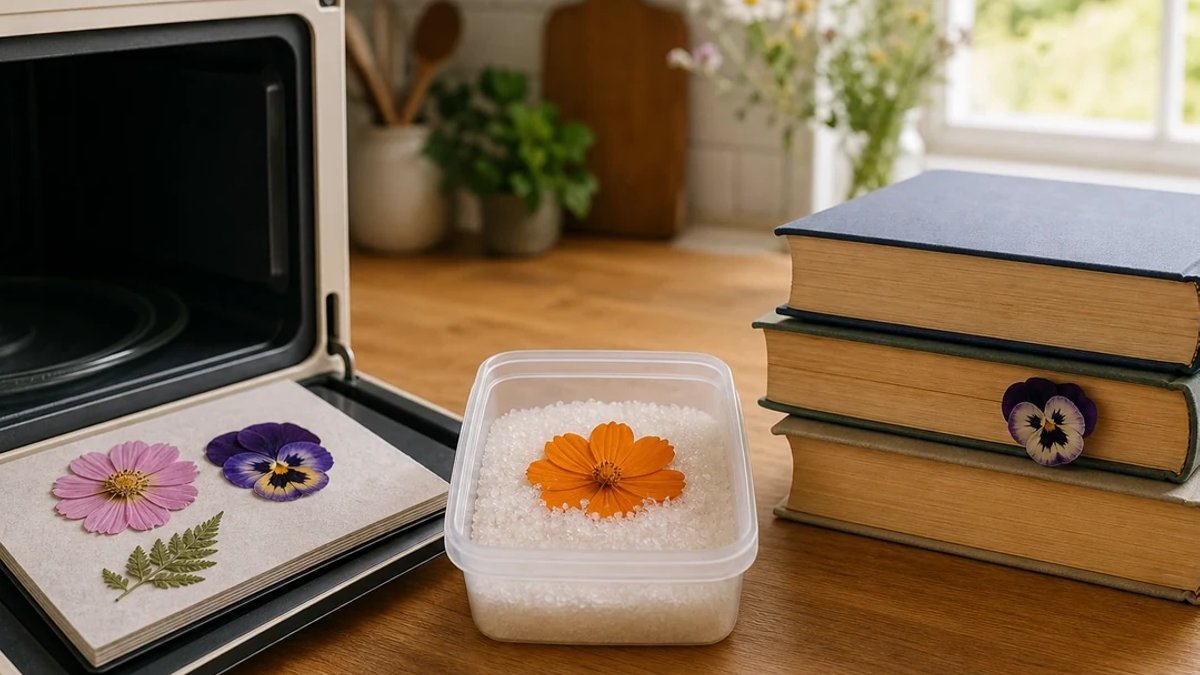
July gardeners face a familiar race: cosmos, pansies, zinnias and violas all peak at once, and the window to preserve that color before it fades is narrow. Three main methods compete for the job — the three-week book press, silica gel, and a microwave hack that promises results before coffee cools. For flat pressed-flower art needed today, the microwave method wins. It collapses the wait into under five minutes and locks in brighter color than slower techniques, according to extension guidance.
The Book Press: Free but Slow
The classic book press asks for almost nothing: a flower, two sheets of absorbent paper, and something heavy. Parchment paper outperforms printer paper because it wicks moisture without sticking to petals. Lay the bloom flat between sheets, slip it deep into a thick hardcover book, then stack three or four more books or a brick on top.
The steady weight flattens petals while paper slowly draws moisture out over days. But that slowness is the catch. As pigments oxidize during the passive drying, book-pressed flowers often come out duller than they went in. The University of Maryland Extension recommends two to three weeks of complete drying, with a paper change after the first week to swap out the damp sheet.
Two to three weeks is a long time for moisture-rich petals to sit in humid summer air. That is the window where colors fade and brown, thick blooms mold before finishing, and shifting book stacks warp petals unevenly. It delivers nothing for weekend projects and suits only no-cost, no-rush efforts with no deadline.
Read Also: Michelle Ogundehin biography and career highlights
Silica Gel: Shape Over Speed
Silica gel dries flowers in three dimensions, preserving the natural form of roses, peonies and cupped cosmos rather than flattening them. Fine crystals bury the bloom and pull water out fast while cradling the flower intact. Lay a base layer in an airtight container, set the bloom face-up, then gently sift more crystals around and over the petals until covered.
Seal the container and wait. The University of Missouri Extension details the desiccant technique, and the New York Botanical Garden notes that big, fragile blooms fare far better in silica gel than air-dried, where they shrivel beyond recognition. The crystals signal when they are working: white sand flecked with blue turns pink at saturation, cueing a recharge in the oven. The gel is reusable, so the upfront cost amortizes over years.
But silica gel produces a three-dimensional dried flower, not a flat pressed one — the wrong tool for cards or framed silhouettes. The crystals are messy and must be brushed off delicate petals with a soft brush. Petal-shedding flowers like poppies tend to fall apart in the process. A conventional silica dry runs two to five days, longer for thick buds, though a microwave-assisted version in 30-second bursts cuts that to minutes.
Microwave Method: Step-by-Step Speed
Microwave presses collapse the three-week wait into under five minutes, according to University of Maryland Extension guidance. The process begins with plain, unpatterned paper towels laid flat on the counter. Cut blooms are arranged face-up, spaced at least half an inch apart, then covered with a second sheet before sliding the sandwich into the microwave.
A heavy ceramic dish weighing down the top keeps petals flat during heating. Short 20–30 second bursts drive off moisture rapidly, with checks between each cycle. Total microwave exposure typically ranges from 30 seconds to two minutes. Once the petals feel papery and dry, the press must cool completely before opening to prevent curling.
Read Also: Woman converts bathroom into home office
White and pale flowers brown readily under heat, making orange and pink cosmos safer bets than ivory pansies. Practice runs with less-precious blooms help dial in timing since microwave wattage varies. Overcooking by even one burst scorches delicate petals, so patience between zaps pays off.
Choosing Flowers and Storing Results
Bright, saturated single-layer blooms press most reliably, including orange and pink cosmos, deep purple pansies, blue larkspur, daisies, and buttercups. These flowers hold their color well across all three methods when picked at the right time.
Thick or water-rich blooms like begonias and succulents mold or scorch instead of drying cleanly, according to extension guidance. Roses and peonies require special handling — halved with a craft knife, pressed petal by petal, or moved to silica gel where their bulk becomes an asset. Whole versions of these blooms fail in flat pressing due to uneven moisture distribution.
Finished pressed flowers need dry, airtight storage away from direct sunlight, which fades color over time. Flat storage in sealed containers prevents curling and mold. Any bloom showing signs of moisture or mildew should be removed immediately, as one damp flower can spoil an entire batch. Under-glass displays or floating frames offer both protection and presentation once the flowers are fully dry.


