
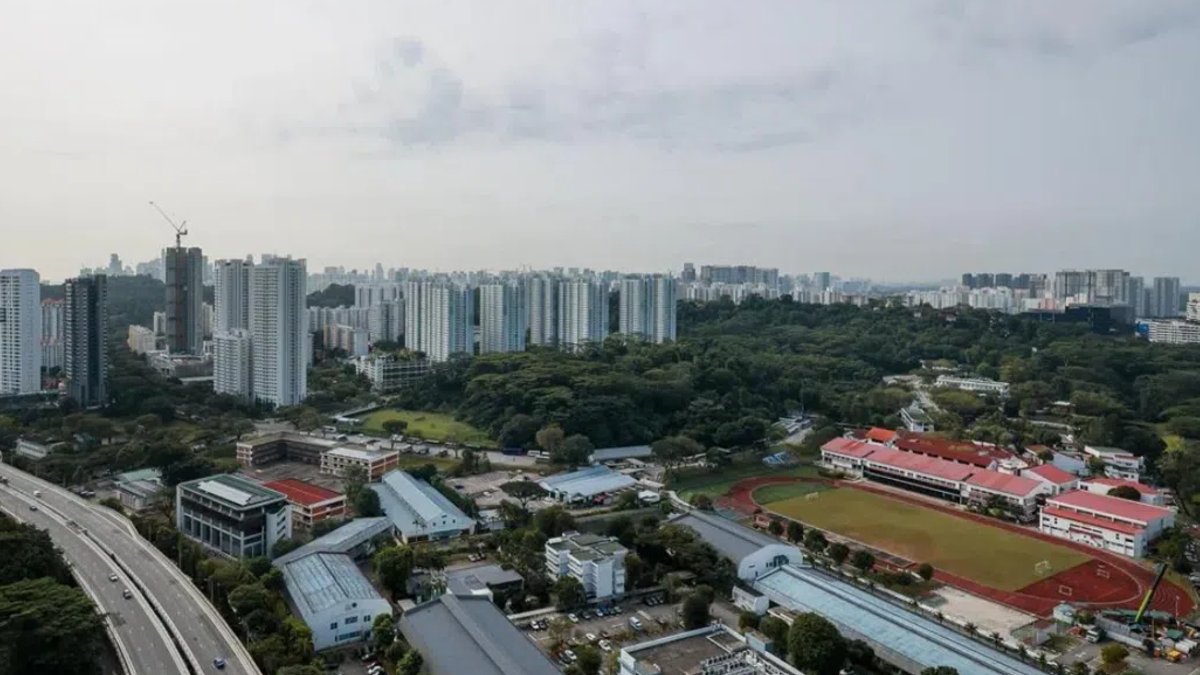
The Housing & Development Board (HDB) has revealed plans to transform Gillman Barracks into a residential estate featuring both public and private housing, while preserving 25 historically significant buildings from the site’s military and educational past. The announcement on July 10, 2026, came alongside reports detailing heritage and environmental studies conducted prior to the redevelopment. The new development will cover 40 hectares, with about a fifth of the estate dedicated to green spaces, blending existing vegetation with newly planted areas. This area currently serves as a hub for creative lifestyle, arts, and food and beverage establishments, but the site’s history dates back much further.
Related: Industry Growth Outlook for This Year Released
Conservation consultancy Studio Lapis conducted a heritage study on 86 state-owned buildings and various site features, including key roads and the open courtyard of the former Alexandra School. The report examined the site’s history across several distinct eras. These include the mid-1930s to 1971 when the area was a British military camp, the 1970s to 1990s when it housed Singapore Armed Forces (SAF) troops, and the period when educational institutions such as St Andrew’s Junior College (SAJC) and Pasir Panjang Vocational Institute (PPVI) opened there. Since the 2000s, the site has been largely used as an arts and lifestyle destination.
The buildings were grouped into seven clusters based on their historical function. These include a school and housing cluster in Preston Road, two clusters associated with Gillman Barracks in Lock Road and Malan Road, the SAJC cluster, the PPVI cluster, and a final cluster of buildings providing public utilities for Telok Blangah. Of all the structures studied, four were assessed to have exceptional significance. These include the original block of Alexandra School in Preston Road, as well as three blocks in Lock Road that belonged to the barracks—a military camp completed in the mid-1930s that originally accommodated the British Middlesex Regiment.
Related: Are Led String Lights Dimmable
Block 22 Lock Road, for instance, was once the sergeants’ mess of Gillman Barracks. Of the three Lock Road blocks, Block 6 housed the headquarters of the Singapore Combat Engineers during the SAF era, Block 9 was where the British Navy, Army and Air Force institutes were sited, and Block 22 served as the sergeants’ mess during the British military days. A further 27 buildings were assessed to be of high significance. The HDB stated that six of these will be demolished as they are in areas required for essential infrastructure such as roads, while 21 will be retained. This means none of the buildings built by SAJC or the vocational institute—which both officially opened in the 1970s—will be retained based on current plans.
Among the structures to be kept are some in the Lock Road cluster used for military administration, social, and communal facilities, as well as some in the Malan Road cluster that served utility and support functions like workshops, garages, and medical facilities. The HDB noted that these former barrack buildings could be repurposed as commercial spaces and amenities for residents, or used for community activities. In Preston Road, 14 of a string of 16 garrison-style semi-detached houses built between 1935 and 1939 will also be retained. These houses once housed military personnel and Alexandra School staff. Additionally, the Telok Blangah Substation, completed in 1974 and essential to providing electricity for the then fledgling new town, will remain in operation. Designed by architectural firm Kumpulan Akitek, the substation is notable for its modernist facade featuring a bronze-anodised aluminium curtain wall.
Related: Cleaning Solar Panels: Why
Professor Ho Puay Peng from the National University of Singapore’s Department of Architecture said he was encouraged that clusters of buildings are slated for retention. “The buildings have more value in clusters, and their significance is expressed in a group rather than as individual buildings, so taking this approach is the right thing to do,” Ho said. He added that keeping parts of SAJC and the vocational institute would be challenging because the area towards the south of Gillman Barracks is low-lying. This would require raising the ground to mitigate flood risks if those parts were to be retained. Tan Swee Yiow, president of the Real Estate Developers’ Association of Singapore, noted that incorporating heritage buildings into development can be a challenge if land parcels are too small. To mitigate this, planners will need to consider parcel sizes to ensure new buildings can be inserted sensitively. He suggested authorities could also exercise flexibility with building rules—such as fire codes and conservation guidelines—to make working with heritage buildings less onerous for private developers.


