
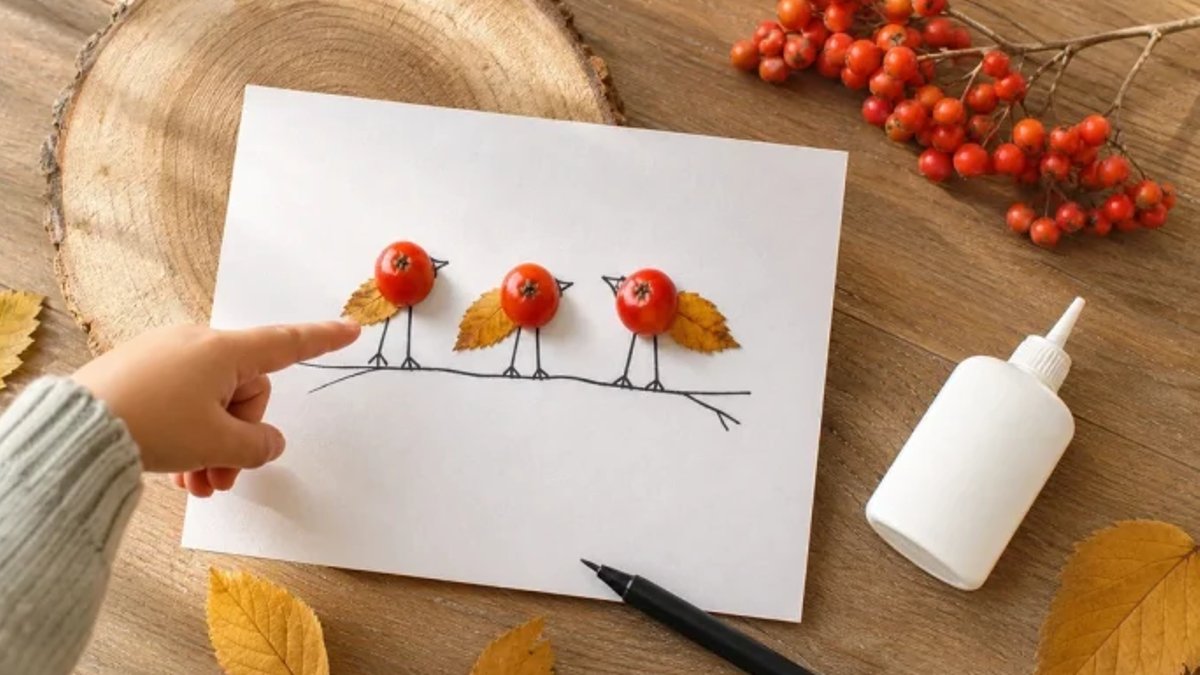
Bright red berries from mountain ash trees are becoming a popular, hands-on fall craft for children. Alongside sidewalks, in parks, and near woodland trails, these trees produce clusters of rowan berries—also known as mountain ash berries—that can be gathered and transformed into simple bird decorations in about 20 minutes.
The craft uses two common varieties: the native American mountain ash, found in the Northeast and upper Midwest, and the European mountain ash, often planted as a street tree in northern states and the Pacific Northwest. Both types yield berries that form the belly of a small bird, with a leaf serving as the wing and a marker creating the legs and beak.
How to pick and prepare the berries
Before gluing, berries must air-dry for one to two days on paper towels. This process reduces their bitterness and improves adhesion. The best way to collect them is on a dry day: snip off entire clusters with scissors, then separate the best berries at home. Discard any that are soft or damaged, frozen berries become mushy once thawed.
Read Also: Microwave dries flowers faster than traditional presses
Botanically, these are small pome fruits, measuring roughly between 1/4 and 3/8 inch in diameter, making them ideal for a bird’s belly without requiring shaping. Leftover clusters can be repurposed into berry wreaths, while pinecones and leaves gathered during collection can be used for other autumn decorations.
Birds such as cedar waxwings and robins consume mountain ash berries rapidly, sometimes stripping an entire tree in a few days. The National Audubon Society identifies mountain ash as a top fall food source for migrating songbirds. If gathering berries, leave most clusters on the tree to support wildlife, as these fruits are essential to their diet.
Step-by-step guide to the berry bird craft
The project requires minimal supplies: heavy poster board or a wood slice for the base, craft glue, a fine-tip marker, and the berries and leaves. Thin printer paper is unsuitable, the moisture from the berries and glue will cause it to warp within days.
Read Also: Michelle Ogundehin biography and career highlights
Begin by sketching a gently curved pencil line across the board to represent a branch. Place two or three dots of glue along this line, each for a bird. Press the plumpest berry onto a glue dot as the belly, then position a smaller berry slightly above and to the side as the head. Attach a dried leaf against the belly, angled upward as if the bird is in flight. Use a black marker to draw two thin legs extending to the branch line, a small triangle for the beak, and a dot for the eye.
Craft glue takes 30 to 60 minutes to set, keeping the design flat during this time. Three birds in a row create the appearance of a branch with inhabitants. Children as young as four can complete all steps independently, often enjoying the marker phase the most.
This approach can be adapted for other crafts, such as paper-plate animals, or layered onto existing fall leaf artwork. If pressed leaves were collected earlier, the berry birds can simply perch on those branches.
Read Also: Woman converts bathroom into home office
Material choices affect durability. Poster board with craft glue offers a quick method but lasts only one to two weeks. Water-based glue struggles to bond with smooth berry skin, and the berries begin shrinking by day three or four, causing the glue to fail. Framing without glass or using a spacer strip reduces moisture buildup, but the craft still rarely survives beyond two weeks.
A wood slice with hot glue provides greater longevity. Berries dried for a day or two lose surface moisture, allowing hot glue to adhere to both the berry skin and the wood grain. This bond resists later shrinking, extending the craft’s lifespan to weeks or even months. However, hot glue requires adult handling due to burn risks, children can place the berries while adults apply the glue.
Safety and storage tips
The NC State Extension plant toolbox confirms that while rowan berries are only mildly toxic, their small size and bitter taste reduce the risk of accidental ingestion. Parents should still supervise children under four, as whole berries could pose a choking hazard. Wash hands afterward, and any broken berries go straight into the trash. If a handful does end up in a child’s mouth, call Poison Control at 1-800-222-1222, the line is staffed around the clock, nationwide and free.


