
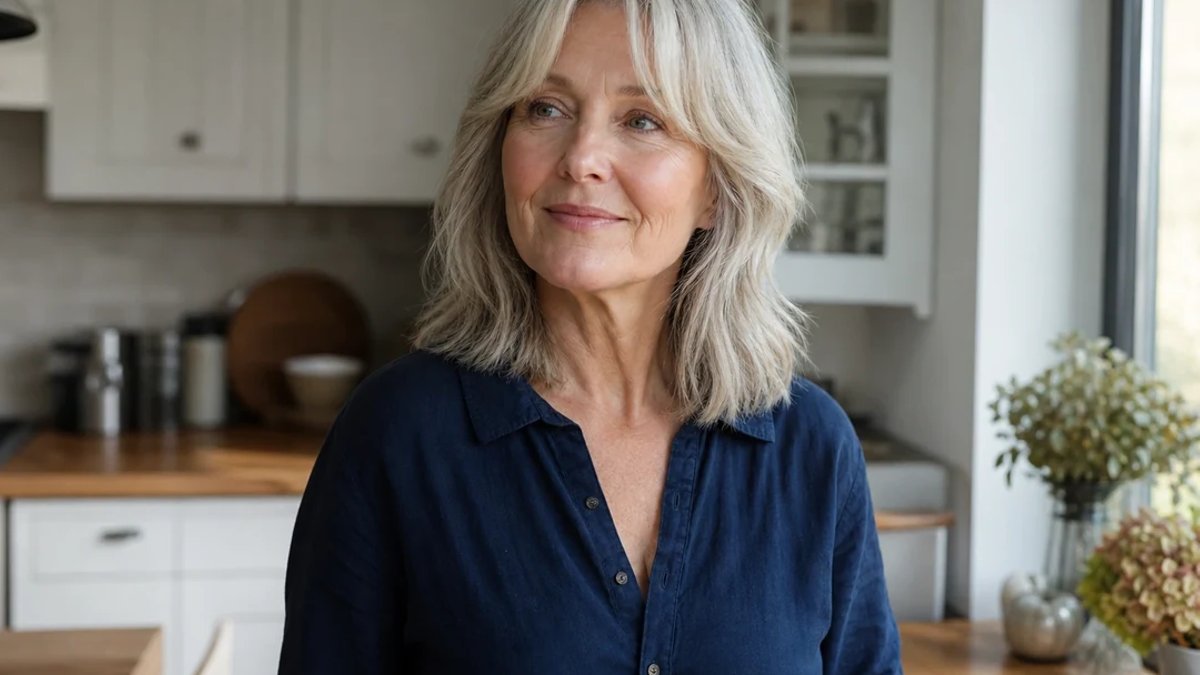
The wolf cut has moved from teenage trend to a specific style for women over 50, but the version on salon mannequins and social media rarely works for mature hair. The original cut relies on long, dense hair and heavy disconnection between a spiky crown and thin tapered ends. For women over 50, that silhouette usually reads as thinning rather than intentional. Stylists are instead cutting a softer, mature shag that keeps a solid weight line at the bottom and uses interior layers to lift the surface hair.
The structural difference
The mature shag haircut maintains a solid bottom edge, with the stylist creating a strong, clean line at the chin, jaw, or collarbone, which remains untouched. The shaping occurs beneath the surface, where shorter layers are cut to support the longer hair above, ensuring the perimeter looks dense and not see-through, even for fine hair. Stylists explain that the layers provide volume, while the solid bottom line adds credibility to the style.
Read Also: Simple fall craft turns rowan berries into bird decor
The ends receive point-cutting rather than razor work. The shears go into the ends vertically, leaving each section slightly uneven so the tips do not clump into a thin curtain. Bangs are blended into the face-framing layers instead of being cut as a separate short chunk, so a curtain fringe sweeps into the length rather than sitting on top of it. Length is the third lever, and removing every inch below the jaw gives the roots less weight to fight.
Why the shape works on thinning hair
Graying hair doesn’t occur uniformly, and stylists use this to their advantage. As follicles produce less melanin over time, graying typically starts at the temples and spreads across the scalp. Cutting layers low and underneath softens this contrast, while high, surface layers emphasize it. Gray hair is also thicker and grows faster, and a shag cut can turn the wiry hairs at the crown into a feature, adding lift to the style.
Female pattern hair loss becomes more common after menopause. The part widens and hair near the temples can recede. Those are the two zones a mature shag needs to cover, not expose. A disconnected cut fails here because it puts the widest part of the silhouette at the temples. The shag adds the appearance of density; it does nothing to the cause. If the part has widened noticeably or shedding has increased, the American Academy of Dermatology recommends seeing a board-certified dermatologist rather than a colorist.
Read Also: Microwave dries flowers faster than traditional presses
Some hair types will hold this shape for only half a day. Very fine, straight, and sleek hair with no wave will slide flat after a few hours without the right products. The collarbone version works best on straight-to-wavy medium density, while coarse gray curls respond well to a dry cut where the stylist works curl by curl. The most reliable choice for hair over 50 remains the soft wolf bob at chin-to-jaw length with blended curtain bangs. It covers the part and temples and provides high crown lift without removing surface length.
When styling with glasses, curtain bangs should end at or just below the brow line, avoiding the top of the frames. Bangs resting on glasses can smudge lenses and lose their shape. For round or full faces, a center-split fringe and layers starting below the cheekbone can elongate the face, rather than widening it.
Styling it in late-summer humidity
In humid conditions, hair expands due to water molecules bonding with keratin proteins, causing frizz. This is manageable and not permanent damage. The key is to understand that the hair’s behavior changes with humidity, leading to a fuller appearance.
Read Also: Michelle Ogundehin biography and career highlights
The Physics of Humidity and Heat Limits
In humid air, water molecules slip into the strand and form extra bonds between proteins, causing the fiber to fold back on itself. This expansion makes the head appear frizzier and fuller than indoors. Managing this requires a specific order of operations. Apply root-lift mousse only to damp hair at the crown and along the part. Never spread it over the entire head, as this weighs down the surface sections the layers are meant to lift.
Heat limits and product rules
Blow-drying pushes the surface of the hair to roughly 175°F. The contraction stress around the cuticle sheath can lift cuticle cells and start cracks. Set your flat iron or curling iron well under the 285°F threshold identified in lab research on hair fibers. Below that, structural changes are largely reversible; above it, the damage to the keratin structure is not.


