
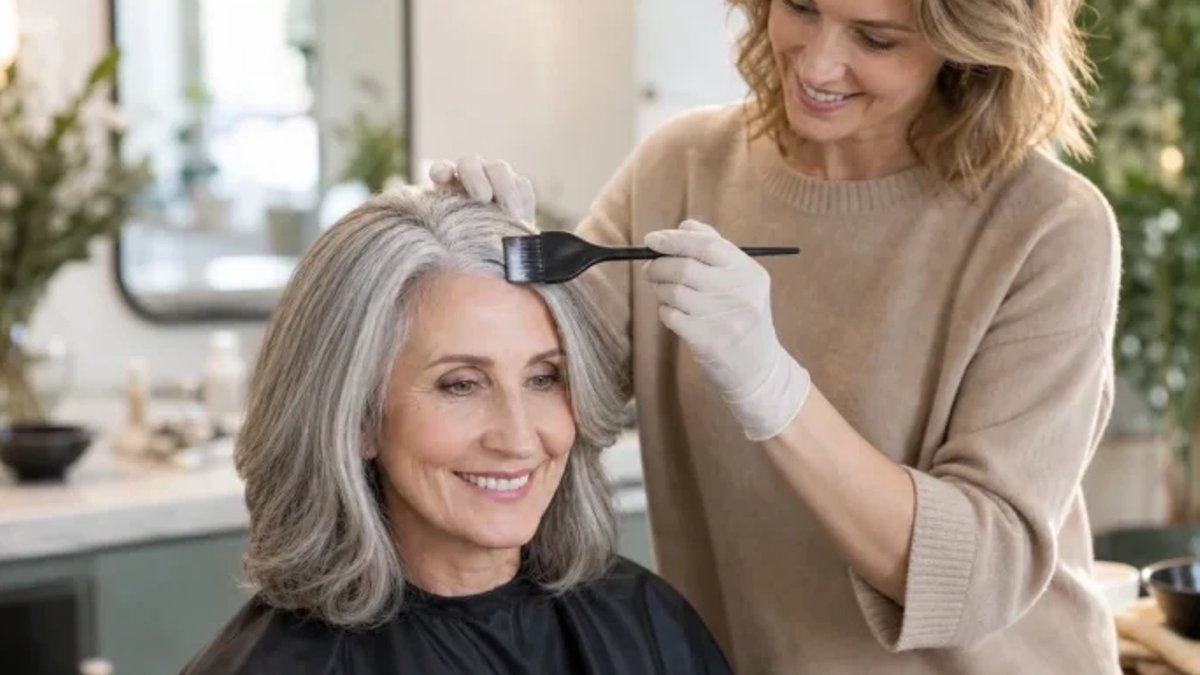
A salon gloss is the simplest and safest way to refresh dull gray hair this season, with treatments starting at around $30 and lasting four to six weeks. Unlike toned silver options, it carries no color risk and works by smoothing the hair’s cuticle—a critical need for gray hair, which is naturally drier and more porous. The treatment does not cover gray strands but instead makes them reflect light more evenly, producing a clearer silver tone almost immediately.
The process relies on basic science: gray hair scatters light rather than reflecting it because its rough texture disrupts shine. A gloss’s slightly acidic formula, with a pH range of 3.5 to 4.5, flattens the cuticle and seals it shut. This approach introduces no pigments or color changes. The outcome is a polished, luminous finish that preserves the hair’s natural shade without alteration.
Professional salon glosses outperform at-home alternatives in durability. In salons, the effect lasts up to 25 washes, whereas drugstore shine masks fade within three to five washes. The key to maintaining the gloss’s longevity lies in patience: waiting 24 to 48 hours before shampooing after the treatment is essential. Skipping this step significantly shortens the shine’s duration.
Read Also: Wolf Cut Evolves for Women Over 50
Clear vs. Toned: Avoiding a Violet Cast
A clear gloss is the safest option for nearly white or very light gray hair, as it contains no pigment and eliminates any risk of unwanted color shifts. However, it cannot neutralize yellow tones, which require a toned silver or charcoal gloss instead. The challenge arises because porous white-gray hair absorbs violet pigment unevenly, potentially leaving a noticeable lilac shimmer if the product remains on too long.
Independent consumer testing of purple shampoos revealed that only seven out of 20 products effectively neutralized yellow tones. For precise results, a salon consultation, including a strand test, is the most reliable method to avoid a violet cast. Processing times vary, ranging from five to 30 minutes depending on hair condition, and must be closely monitored.
Scheduling and Preservation Tips
Salon gloss treatments should be booked every six to eight weeks, ideally during a trim to maintain the effect between appointments. At-home versions begin at around $15, though they lack precision and durability.
Read Also: Simple fall craft turns rowan berries into bird decor
Toned glosses carry a real risk of a violet cast on white-gray hair. The uneven surface of porous strands traps pigment in patches, creating dull, uneven shades if left on too long. Violet pigments fade within 10 to 12 washes, often revealing the original yellowing underneath. Stylists recommend a strand test, applying the gloss to a hidden section first, to determine how the hair will react. If the test strand develops a noticeable lilac hue, clients should use clear gloss or a different shade instead.
How a Gloss Works on Gray Hair: The Science Behind the Shine
A gloss treatment improves the appearance of dull gray hair by altering the hair’s surface rather than changing its color. The process involves a slightly acidic solution that temporarily smooths and seals the cuticle layer, which is naturally rougher and more porous in gray hair. This sealing effect allows light to reflect more evenly, creating a brighter, more polished look without altering the hair’s underlying shade.


