
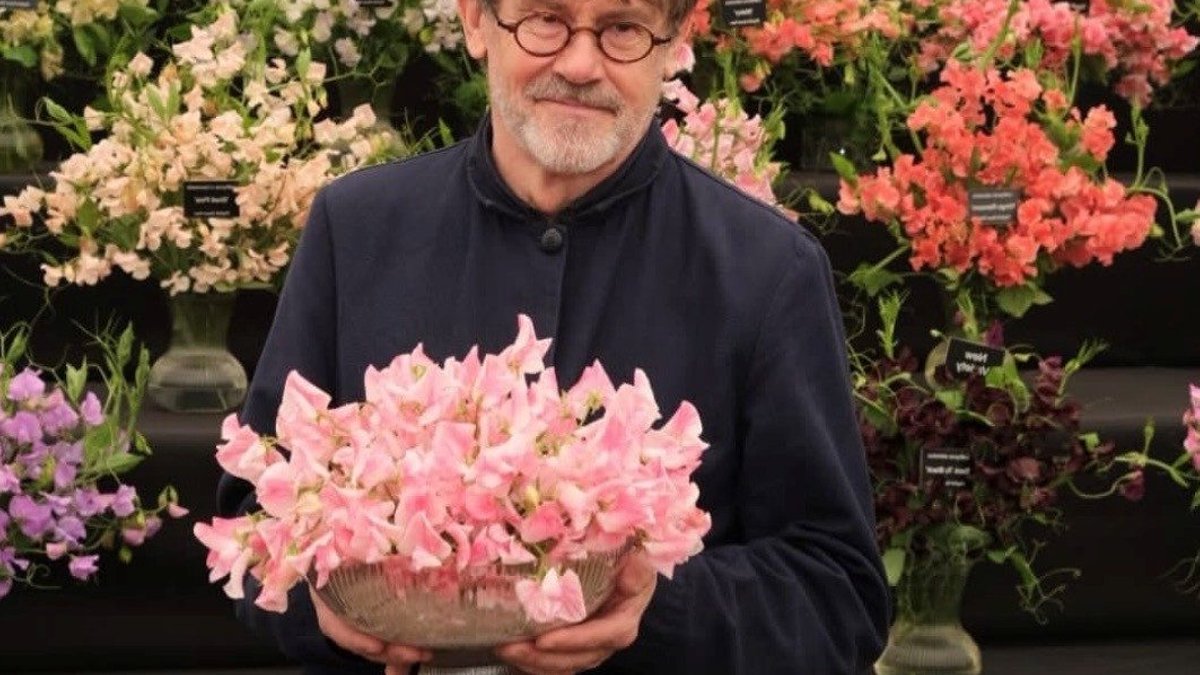
Naming a flower is harder than it sounds. When food writer and gardener Nigel Slater was asked to name a new sweet pea cultivar, he approached the task with the same care as naming a child—something he had never done before meeting the plant.
“To get it wrong would be like giving an unsuitable name to a child,” he wrote. The name had to reflect the flower’s character, not just its color.
The moment that inspired a name
The new sweet pea, bred by Phil Johnson of English Sweet Peas, has white petals brushed with pale strawberry-pink stripes. To Slater, the delicate blush suggested a summer dessert: a fruit fool—crushed strawberries swirled into softly whipped cream. The moment when the fruit’s juices streak through the cream became the perfect image.
“Mix too much and you will have a pale-pink pudding,” he noted. “If you know when to stop, you create something ethereally beautiful.” That fleeting, half-mixed state defined the inspiration. The cultivar is now called Lathyrus odoratus ‘Fruit Fool’.
Why plant names carry meaning
Slater has long been interested in how plants receive their names. Some honor botanists—like Begonia (Michel Bégon) or Dahlia (Anders Dahl). Others borrow from royalty, celebrities, or historical figures. His own garden includes roses named after Dame Judi Dench, Roald Dahl, and Gertrude Jekyll, a collection he compares to “the guest list of a particularly eclectic garden party.”
His surname is also tied to a rose. Slater’s Crimson, a Rosa chinensis cultivar, may or may not share his lineage—DNA analysis links it to ‘Old Blush’, an ancient variety seen in early Chinese paintings. “Whether this rose is even remotely connected to me I have no idea,” he said, “though I’ve always liked the idea that it might be.”
Some names hold significance beyond their origins. Queen Anne’s lace might refer to any of several queens, while St. John’s wort honors John the Baptist. Roses alone feature a roster of monarchs, from ‘Princess Anne’ to ‘The Queen Elizabeth’.
Related: Expat reveals best Singapore neighbourhoods for you
For Slater, common names hold the most charm. Few gardeners call a snowdrop Galanthus or a foxglove Digitalis. “When did you last hear anyone say, ‘Oh look, the Lamprocapnos spectabilis is out’?” Names like bleeding heart or lady’s mantle carry poetry. “There is a touch of fairy-story to them,” he wrote, “just as poison ivy and deadly nightshade suggest mystery and darkness.”
He recognizes the importance of botanical names for precision in horticulture. But in his own garden, he prefers the whimsy of lamb’s ear over Stachys byzantina.
A gardener’s vigil
This summer, Slater is tending his sweet peas carefully. ‘Fruit Fool’ will share a trellis with ‘Mrs Collier’, ‘High Society’, and ‘Almost Black’, a mix of whites, purples, and pinks he hopes will fill a vase. The biggest threat remains slugs.
“Much depends on keeping the dreaded slugs at bay,” he said.
For Slater, the experience showed how names shape our connection to nature—whether a rose named after a historical figure or a sweet pea that evokes summer.
“Plant names, whether botanically accurate or simply common names that have endured, are worth preserving,” he wrote. “They evoke images that stay with us forever.”


